← Roni Arbel, MD PhD ASDP 2026 · Melbourne

Poster · ASDP 2026, Melbourne

Rapid and prolonged plasticity in the ventral visual stream during reading through sound

Is cortical specialisation sensory-dependent or task-specific?

Reading normally recruits specialised regions of the left fusiform gyrus, deep in the brain's visual stream. So what happens in a brain that has never seen? Congenitally blind adults learned OVAL, an orthography in which every letter is a shape you hear rather than see, and whole-brain fMRI followed their cortex as they learned to read with it.

Presented at
14th Annual ASDP Conference Australasian Society for Developmental Paediatrics
When
20–22 August 2026 Pullman Melbourne, Albert Park
Authors
Roni Arbel, Benedetta Heimler, Amir Amedi
Affiliations
Hebrew University of Jerusalem · Reichman University Hadassah · Sheba Medical Centers

Presenting this work in Melbourne

Roni is presenting this poster at the Australasian Society for Developmental Paediatrics' fourteenth annual conference, whose theme this year is Development and Learning: Unlocking the Puzzles — a program built around where the clinic meets the classroom. Fittingly, the poster closes on a panel of its own headed “unlocking the puzzle”.

The question it puts to a room of developmental paediatricians is a practical one. If the brain's reading machinery organises itself around what a task demands rather than around the sense that delivers it, then a child who reads by ear or by fingertip is not making do with a workaround. They are using the same circuitry, reached by another road.

If you are at the conference, come and find the poster — or write ahead and Roni will make time to talk.

  • ConferenceASDP 2026, fourteenth annual meeting
  • ThemeDevelopment and Learning: Unlocking the Puzzles
  • DatesThursday 20 to Saturday 22 August 2026, with pre-conference workshops on Wednesday 19 August
  • VenuePullman Melbourne, Albert Park, Victoria
  • FormatPoster presentation, in person
The poster

Read it as it hangs

The full poster is below. It is a dense one, so open it at full size to follow the panels: the study in brief, how an image becomes sound, the training design, and the two sets of brain maps taken two hours and twelve hours in.

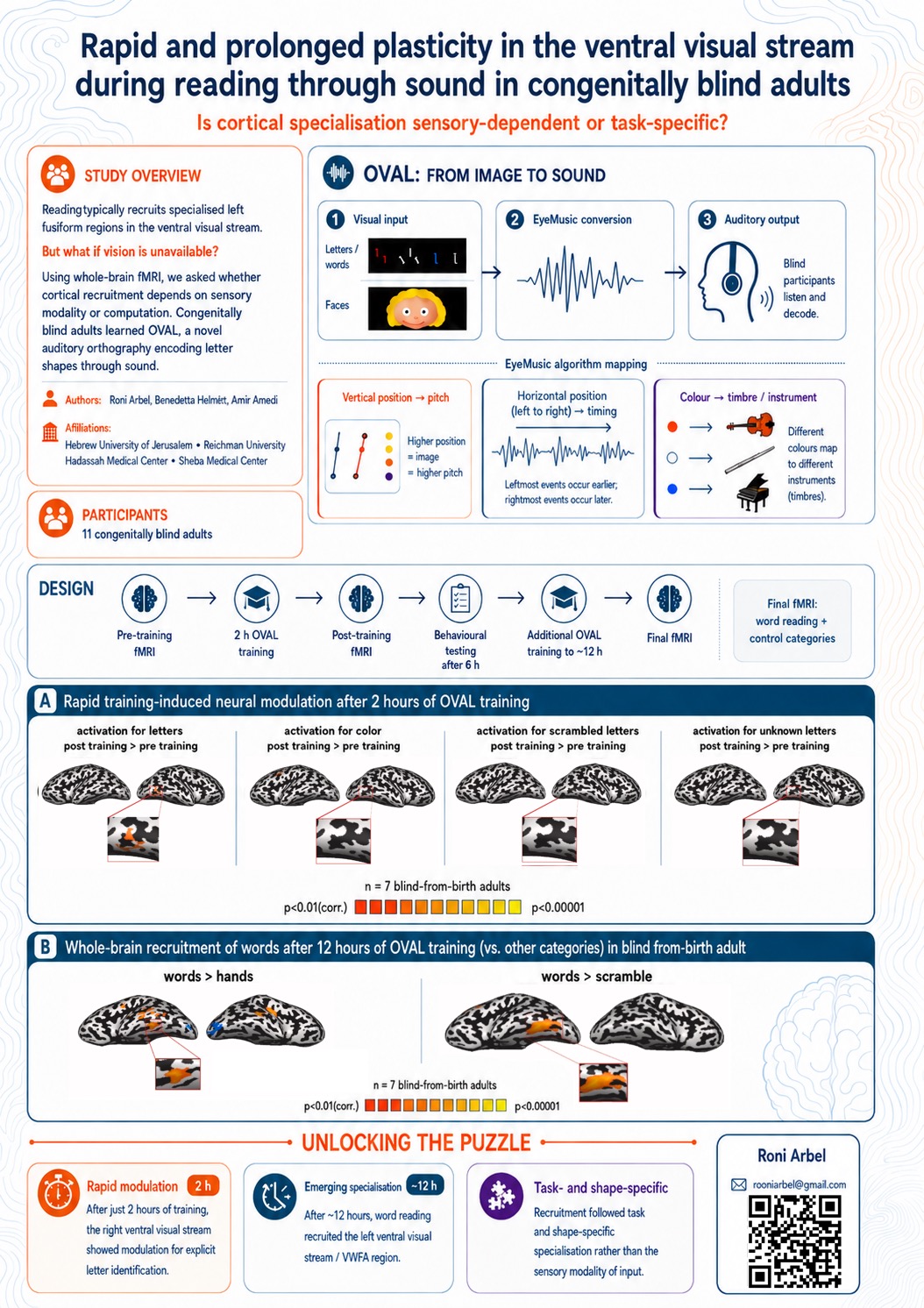
Conference poster titled Rapid and prolonged plasticity in the ventral visual stream during reading through sound in congenitally blind adults. Panels cover the study overview, the OVAL image-to-sound conversion and EyeMusic mapping of vertical position to pitch, horizontal position to time and colour to instrument, the training and fMRI design, brain activation maps after two hours and after twelve hours of training, and three conclusions.

Arbel R, Heimler B, Amedi A. Presented at ASDP 2026, Melbourne. The QR code on the poster points to Roni's contact details.

Findings

Unlocking the puzzle

Three results, in the order the brain produced them.

2 hours

Rapid modulation

After only two hours of training, the right ventral visual stream already showed modulation when participants were asked to identify letters explicitly.

~12 hours

Emerging specialisation

By around twelve hours, reading whole words recruited the left ventral visual stream, at the region sighted readers use as the visual word form area.

The answer

Task and shape, not sense

Recruitment followed the task and the shapes it required rather than the sensory modality the input arrived in. Specialisation here is computational, not sensory.

Method

How the study was run

Eleven congenitally blind adults took part. The brain maps on the poster come from seven of them, all blind from birth, imaged before training and twice after it.

Reading by ear

OVAL is an auditory orthography built for visual-to-auditory sensory substitution. Each of its twenty-two characters is a small arrangement of coloured dots and vertical lines, and the EyeMusic algorithm turns that arrangement into a sound: position from left to right becomes time, height becomes pitch on a pentatonic scale, and colour becomes the instrument you hear — a choir, a trumpet, a piano.

Because the letters keep their shapes, a blind reader learns the same spatial forms a sighted reader learns, through the ear. That is what makes it a fair test of whether the reading regions of the ventral visual stream care about shape and task, or about vision.

The same alphabet, and the same recordings the participants trained on, are playable in your browser.

The training and imaging sequence

  1. Baseline fMRI before any exposure to the script
  2. Two hours of OVAL training on letters
  3. Second fMRI, revealing the earliest changes
  4. Behavioural testing after six hours of training
  5. Further training, to roughly twelve hours in total
  6. Final fMRI: reading words, against control categories
Further reading

The papers behind the poster

Talk about this work

At the conference or after it — for collaborations, clinical opportunities, or a walk through the poster.